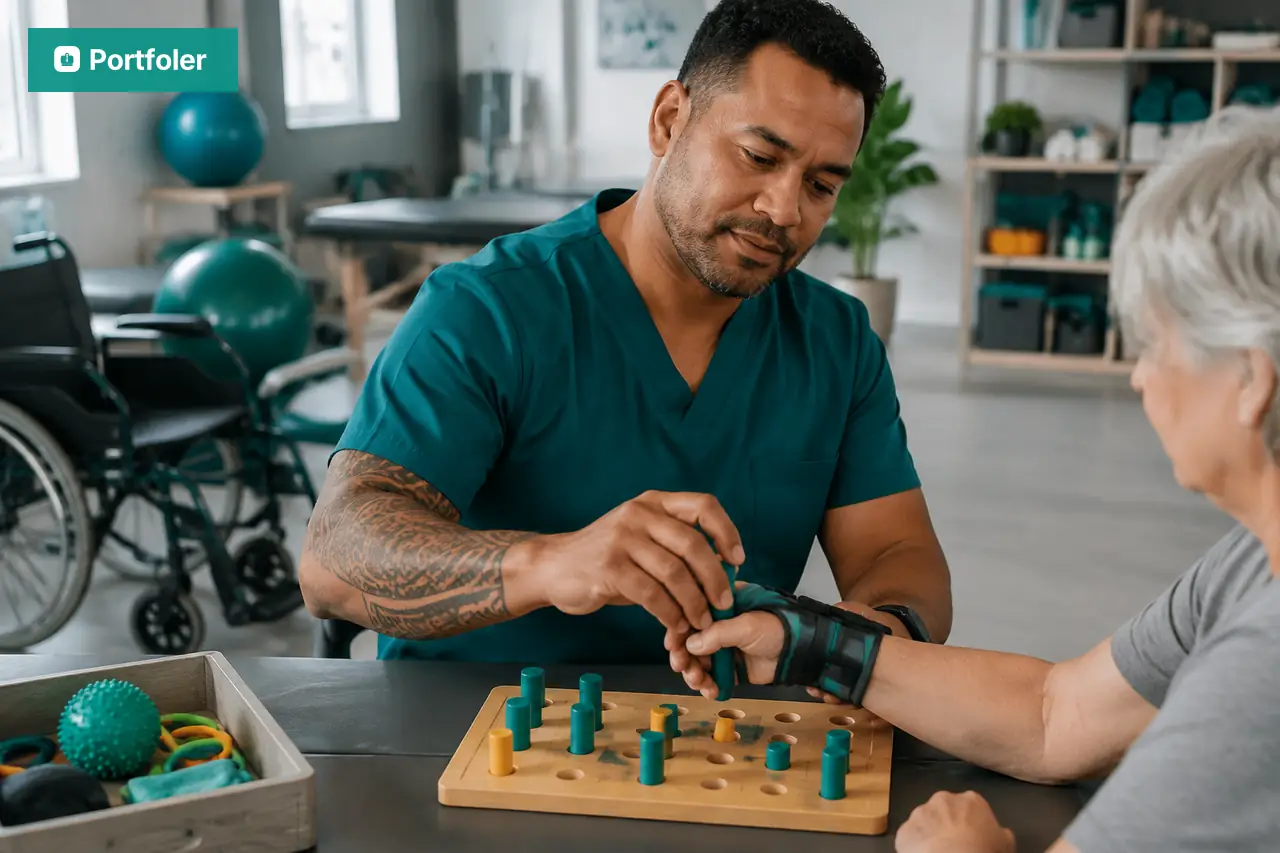
An occupational therapist is a paramedical rehabilitation professional who helps people living with disability, illness or age-related decline regain their independence in everyday activities. Through movement analysis, environmental adaptation and assistive devices, they give patients back the means to act at home, at work and in their leisure.
Role overview
Occupational therapy rests on a simple idea: activity heals. The occupational therapist assesses a person's abilities and difficulties — motor, cognitive and sensory — then designs a programme to restore, compensate or maintain their autonomy. The focus is not on the injury itself but on its concrete consequences: washing, cooking, writing, moving around, working.
A regulated healthcare profession, it requires a state diploma. Occupational therapists work with all ages, from premature newborns to the elderly, alongside doctors, physiotherapists, speech therapists and social workers.
Key responsibilities
- Carry out the occupational assessment: functional, cognitive and environmental evaluation.
- Rehabilitate impaired movements and functions after an accident, neurological disease or surgery.
- Recommend and adapt assistive devices (wheelchairs, orthoses, home automation, digital tools).
- Adapt the home and workplace to make activities safer and easier.
- Design and fabricate custom splints and bespoke devices.
- Support families and coordinate follow-up with the multidisciplinary team.
Required skills
Hard skills: occupational assessment and standardised tests, functional rehabilitation, knowledge of neurology, paediatrics and geriatrics, mastery of assistive devices and splint fabrication, home adaptation and ergonomics, anatomy and pathophysiology.
Soft skills: empathy, patience, keen observation, creativity to find practical solutions, communication and teaching ability, multidisciplinary teamwork.
Salaries around the world
An occupational therapist's pay varies widely by country, practice mode (employed or self-employed) and sector. The salary table by country below gives indicative gross annual ranges, in local currency, for an experienced professional.
Career path
- Junior (0 – 2 years): patient care under supervision, consolidating assessments and rehabilitation techniques.
- Experienced (2 – 6 years): full autonomy, managing an active caseload, gradual specialisation.
- Specialist (6 – 10 years): expertise in paediatrics, neurology, hand rehabilitation or geriatrics.
- Coordination / teaching (10+ years): clinical lead, team coordinator, institute lecturer, private practice.
Education & training
- State diploma / bachelor's degree in occupational therapy over 3 years, entered after secondary school through competitive admission or a health bridge.
- Curriculum combining medical sciences, rehabilitation techniques and clinical placements.
- Valued continuing education: hand rehabilitation, neurodevelopmental disorders, home automation and new assistive technologies.
Industries & opportunities
Occupational therapists work in hospitals and rehabilitation centres, private practice, home care, elderly care facilities, schools and the medico-social sector. Ageing populations, home-based care and disability inclusion sustain steady demand and sought-after profiles.
In short
A human, hands-on and meaningful profession at the crossroads of care, technique and support. If you want to restore independence to those who need it, create your profile on Portfoler.com and connect with the facilities and practices hiring occupational therapists.
 United States
 United Kingdom
 Germany
 France
 Canada
 United Arab Emirates
 Morocco
 India
 Spain
 Australia