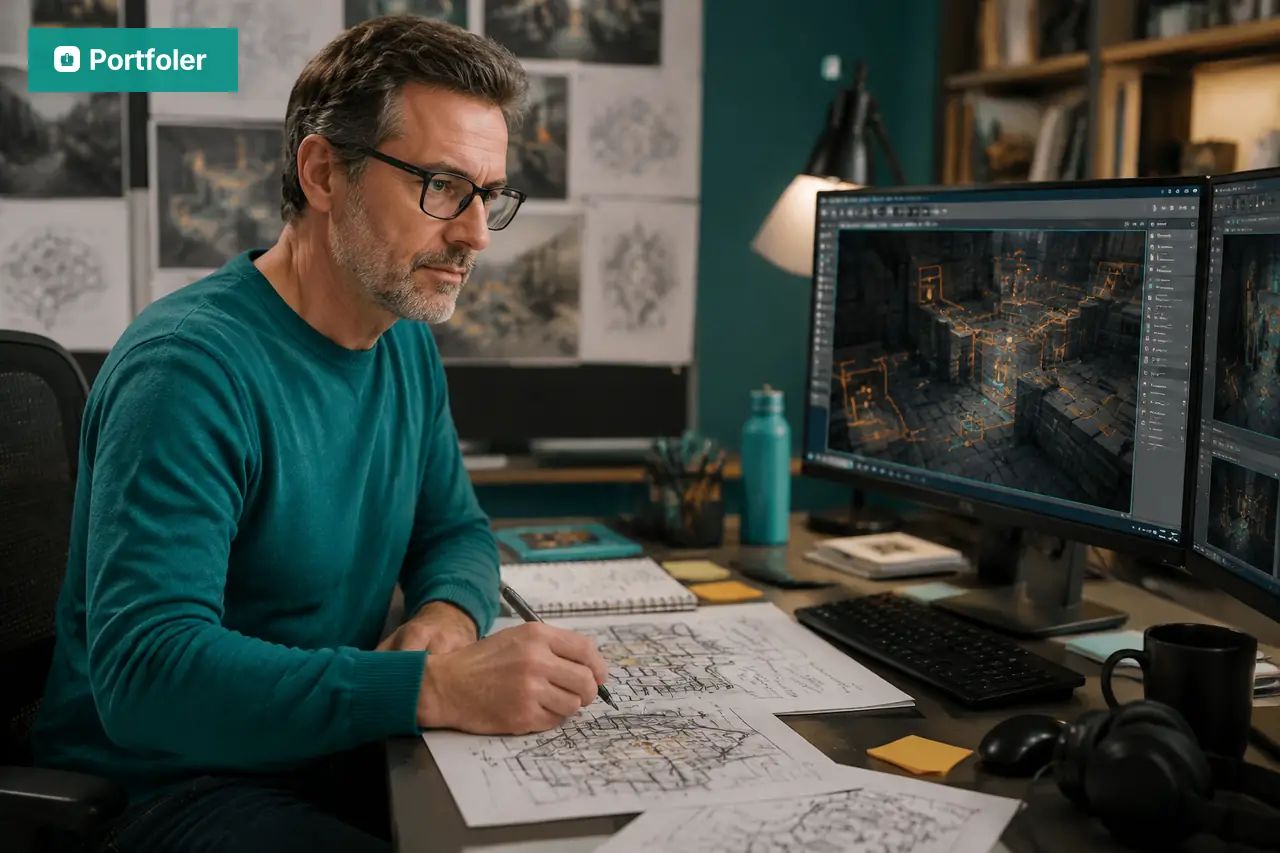
The Game Designer is the architect of the play experience. They imagine the rules, mechanics and systems that make a video game fun, coherent and engaging. At the crossroads of creativity and logic, they turn an idea into a playable experience and work closely with artists, developers and writers. It is a central, highly sought-after role in a fast-growing video game industry.
Job description
The Game Designer shapes the heart of the play experience: the rules, mechanics, systems and gameplay loops that make a game enjoyable to play. They define how the player interacts with the world, which actions are available, how they progress and what challenges they face.
Their work is formalized in design documents (the Game Design Document, or GDD) that describe the play intentions, the internal economy, the progression and the systems in detail. They do not necessarily develop the game themselves, but they drive the gameplay vision and arbitrate every design decision. The Game Designer works as part of a team and collaborates constantly with artists, programmers, level designers and writers to turn an intention into a concrete experience.
Key responsibilities
- Design game mechanics, systems and gameplay loops.
- Write and maintain the Game Design Document (GDD) and specifications.
- Prototype ideas quickly to test their play value.
- Balance the game and run playtest sessions to fine-tune it.
- Contribute to level design and to structuring the progression.
- Collaborate with artists, developers and narrative designers throughout production.
Required skills
Hard skills: writing a Game Design Document, level design, gameplay design, prototyping, narrative design, balancing and systems design, command of engines such as Unity and Unreal Engine, along with design and collaboration tools (Figma, Miro, Jira).
Soft skills: creativity, analytical thinking, communication, a strong sense of the player and iteration. The Game Designer must be able to listen to feedback, challenge their own ideas and refine their work through successive cycles.
Salaries around the world
A Game Designer's pay varies widely depending on the country, the type of studio (AAA, independent, mobile) and the target platform. Experience, specialization (systems, level, narrative) and the size of the project also influence the salary. The salary-by-country table below shows indicative ranges in local currency for a mid-level professional. Large AAA studios and international hubs generally push pay upward.
Career path
- Junior (0 – 3 years): designing specific features, prototyping, working under the direction of an experienced designer.
- Mid (3 – 6 years): owning entire systems, making design trade-offs, autonomy over parts of the game.
- Senior (6 – 10 years): driving the gameplay vision of a project, mentoring, making structural decisions about the experience.
- Lead / Expert (10+ years): leading the design of a studio or a game, with pay well above mid-level ranges.
Education & training
Several paths lead to the Game Designer role:
- Specialized video game schools (game design, production), the most direct route.
- Art or computer science schools (design, development) offering a solid creative or technical foundation.
- Self-taught paths backed by a portfolio of prototypes and personal games, highly valued in this industry.
As in many creative game roles, the portfolio of prototypes often matters more than the diploma: it proves the ability to design and finish a playable experience.
Opportunities and sectors
Game Designers are recruited by AAA studios, independent studios, mobile game publishers, serious game companies and players in virtual and augmented reality. The diversification of platforms — console, PC, mobile, cloud, VR — and the rise of gaming as a medium sustain strong demand, with prospects toward lead design or creative direction.
In summary
Game Designer is a creative and analytical role at the center of video game production, turning ideas into playable experiences. If you can imagine mechanics, balance a system and iterate with a team, create your profile on Portfoler.com, publish your prototypes and portfolio, and attract the studios and recruiters looking for your universe.
 United States
 United Kingdom
 Germany
 France
 Canada
 United Arab Emirates
 Morocco
 India
 Spain
 Australia