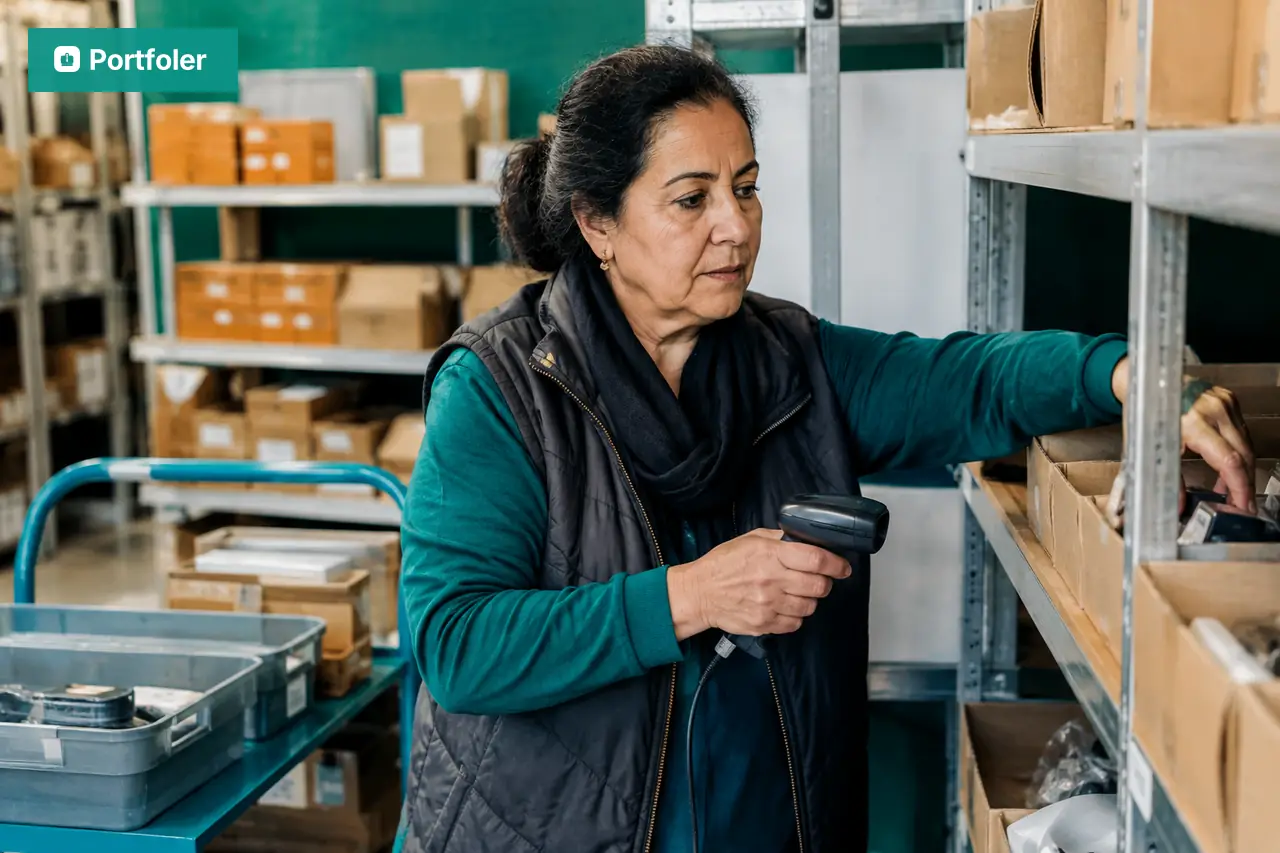
The inventory manager, often called a warehouse clerk, keeps goods available, accurate and in the right place across the warehouse. They receive, store, pick and dispatch products while keeping stock records up to date. A hands-on, essential role, driven by the boom in e-commerce and logistics, with strong demand across every sector.
Job description
The inventory manager (or warehouse clerk) makes sure the right products are available, in good condition and in the right place. They control inbound and outbound flows, organize storage and guarantee the traceability of every item, from the receiving dock to dispatch.
At the heart of the supply chain, they work with a warehouse management system (WMS), a barcode scanner and often a forklift. Unlike the logistics manager, who steers all flows, or the supply chain manager, who sets the end-to-end strategy, the inventory manager acts on the ground, closest to the goods.
Key responsibilities
- Receive, check and store incoming goods.
- Prepare orders (picking) and organize shipments.
- Run inventories and monitor stock levels.
- Optimize warehouse layout and storage.
- Enter and update movements in the WMS/ERP.
- Ensure product traceability (batches, dates, locations).
- Operate handling equipment (forklift, pallet truck) in line with safety rules.
Required skills
Hard skills: stock and inventory management, receiving and dispatching, order picking, WMS and ERP proficiency, barcode scanning, forklift operation (certification), traceability and location management, Excel basics and flow management.
Soft skills: rigor, organization, attention to detail, reliability, teamwork, physical stamina, responsiveness and adherence to safety rules.
Salaries around the world
An inventory manager's pay varies widely from one country to another, depending on cost of living, sector and level of responsibility. The salary-by-country table below shows indicative gross annual ranges, in local currency, for an entry-level to experienced profile. Automated warehouses, large-scale retail and roles involving equipment operation or team responsibility push pay upward.
Career path
The role offers concrete progression, accessible without a high-level degree:
- Handler / Order picker (0 – 2 years): receiving, picking, storage, learning the tools.
- Warehouse clerk / Inventory manager (2 – 5 years): stock keeping, inventories, mastery of the WMS and equipment.
- Logistics team leader (5 – 8 years): managing a team, organizing a warehouse's flows.
- Logistics / Warehouse manager (8+ years): overall steering, budgets and performance — with pay well above.
Hands-on experience and certifications (forklift) speed up the move into management.
Education & training
Several routes lead to the role, often quickly accessible:
- A vocational diploma in logistics (warehouse operator/clerk, stock handling).
- Forklift and handling-equipment certifications for operating warehouse machinery.
- On-the-job training, where experience and tool mastery often outweigh the diploma.
Opportunities and sectors
Inventory managers are recruited across almost every sector: large-scale retail, industry, e-commerce, transport and parcel delivery, pharma, automotive, construction and food processing. The growth of online commerce and warehouse automation sustain strong, lasting demand, with real prospects toward logistics management.
In summary
A hands-on, concrete and sought-after role at the heart of logistics and customer satisfaction. If you are rigorous and at ease in a warehouse, create your profile on Portfoler.com and attract the employers and recruiters looking for your know-how.
 United States
 United Kingdom
 Germany
 France
 Canada
 United Arab Emirates
 Morocco
 India
 Spain
 Australia
 Netherlands
 Brazil