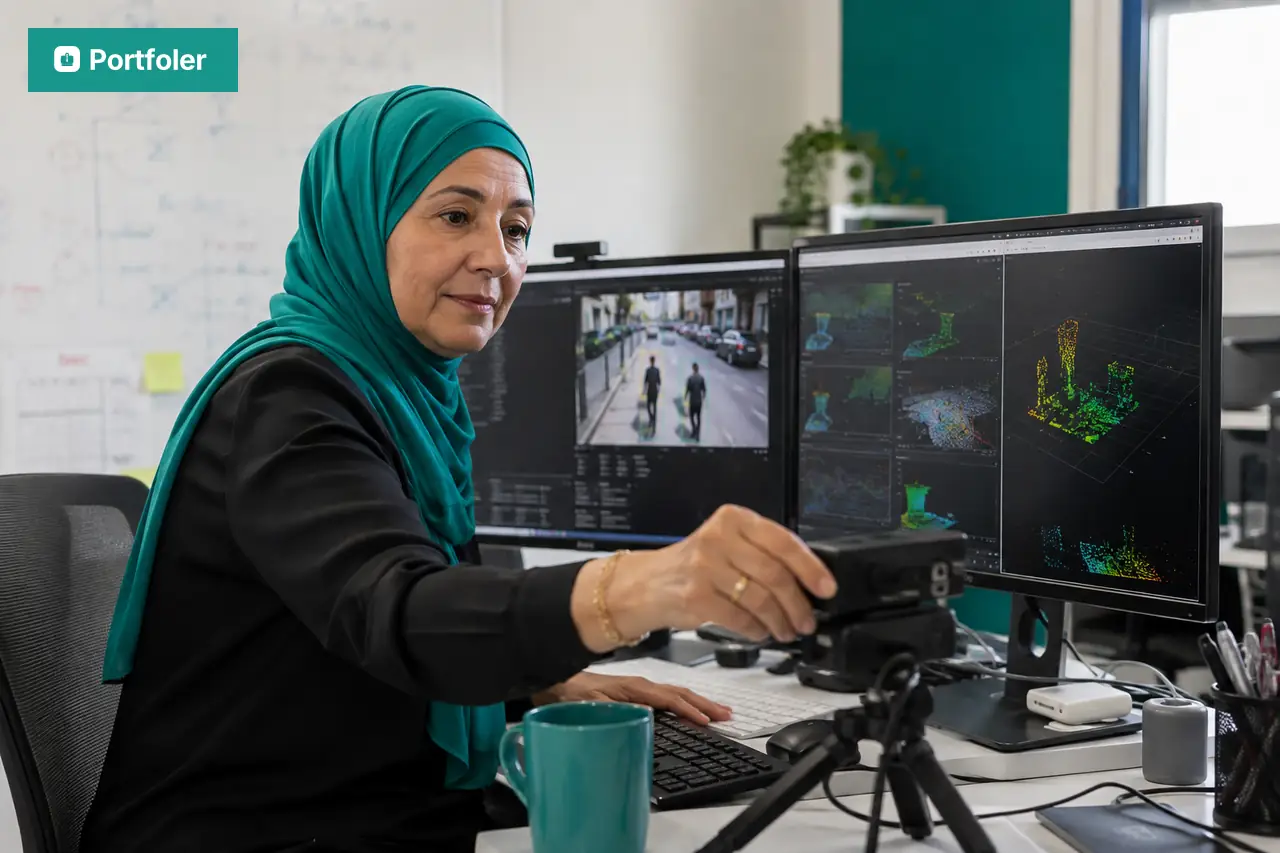
The Computer Vision Engineer is one of the most sought-after AI profiles. They teach machines to "see" and interpret images or videos: object recognition, detection, segmentation, document reading or medical imaging analysis. A role at the crossroads of research and software engineering.
Job description
The Computer Vision Engineer designs, trains and deploys models capable of extracting information from visual data. They turn raw pixels into actionable decisions: counting products on a production line, spotting a defect, tracking a vehicle, identifying a tumor or automating document capture.
Their work combines deep learning (convolutional neural networks, visual transformers), classic image processing and industrial deployment, often under real-time and embedded-hardware constraints (GPUs, edge devices).
Key responsibilities
- Build and annotate representative image or video datasets.
- Design, train and evaluate detection, classification or segmentation models.
- Optimize models for performance and latency (quantization, pruning, ONNX, TensorRT).
- Integrate models into production pipelines and real-time applications.
- Track production metrics and manage model drift (monitoring, retraining).
- Collaborate with data, product, hardware and business teams.
Required skills
Hard skills: Python, PyTorch or TensorFlow, OpenCV, deep learning (CNN, ViT), image processing, C++ for optimization, CUDA/GPU, MLOps and deployment fundamentals (Docker, ONNX).
Soft skills: scientific rigor, an experimental mindset, the ability to explain results clearly, curiosity about the state of the art, and a strong sense of product and real-world constraints.
Salaries around the world
Pay varies widely depending on the country, cost of living and scarcity of the profile. The salary table by country below (fed by `salaires_json`) gives indicative annual gross ranges, in local currency, for a confirmed to senior profile. Refer to the table for details by market.
Career path
- Junior (0 – 3 years): model prototyping, annotation, contributions on isolated components under supervision.
- Mid (3 – 6 years): ownership of production models, optimization, architecture choices.
- Senior (6 – 10 years): design of complete vision systems, mentoring, technical trade-offs.
- Expert / Lead (10+ years): vision R&D leadership, publications, AI platform architecture, significantly higher pay.
Education & training
- Master's to PhD level in computer science, applied mathematics, signal processing or artificial intelligence (engineering schools, master's degrees, doctorate).
- Online specializations (deep learning, computer vision) followed by concrete projects and open source contributions.
- A portfolio of projects (Kaggle, GitHub, publications, demos) often carries more weight than a degree alone.
Opportunities and sectors
The Computer Vision Engineer is recruited in automotive (autonomous driving), healthcare (medical imaging), industry (quality control, robotics), security, agriculture, retail, fintech (KYC, OCR) and AI software vendors. Freelancing and consulting are also thriving.
In summary
A cutting-edge role at the frontier of research and product, with sustained demand and high salaries. If you train models that give sight to machines, create your profile on Portfoler.com and attract the projects and recruiters that match your skills.
 United States
 United Kingdom
 Germany
 France
 Canada
 United Arab Emirates
 Morocco
 India
 Spain
 Australia
 Netherlands
 Brazil