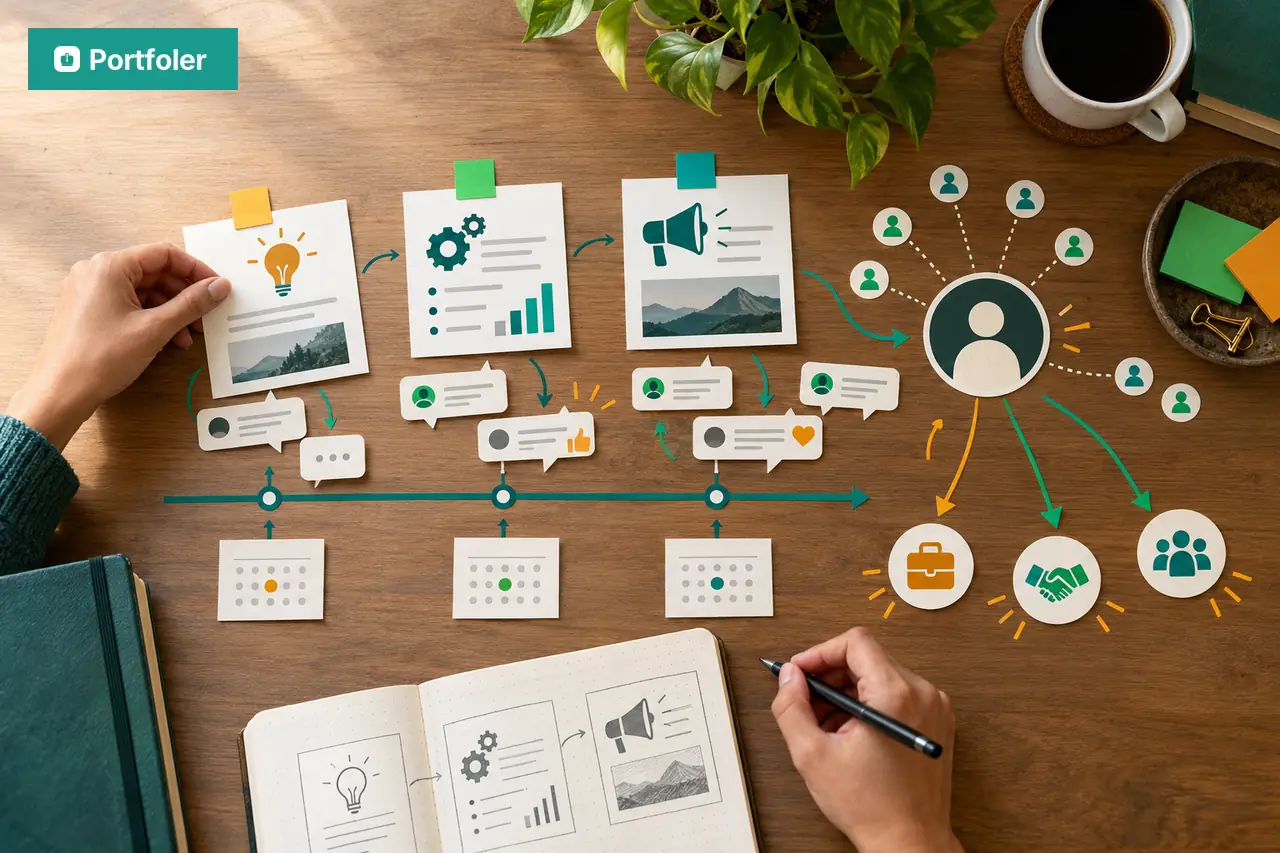
Two portfolios can show the same work and have nothing like the same impact. The first lines up nice images with no context; the second tells, for each project, a problem, a decision and a result. It's the second one you remember. A portfolio doesn't just prove that you *can do the work*: told well, it proves you can *think*. Here's how to turn your work into stories that convince.
Why narrative beats the gallery
An image shows an output; a story shows an approach. And a client or recruiter isn't buying a pretty visual: they're buying your ability to solve their problem.
- Context gives meaning to what we're looking at.
- The narrative proves your reasoning, not just your execution.
- A story is remembered and retold to others — a lone thumbnail isn't.
Showing *what you did* is useful; explaining *why and how* is decisive.
The structure of a good project story
Every project benefits from a simple frame, like a mini case study. This structure works for a designer, a developer, a writer or a consultant.
- Context: the client, the need, the starting constraint.
- The challenge: the real problem to solve, the part that wasn't obvious.
- Your role: what *you* specifically did (especially on team projects).
- The solution: the key choices and why you made them.
- The result: the impact, ideally quantified.
Three lines per step are enough: you're telling a story, not writing a novel.
Show your role and your choices
The trap of team portfolios is letting people believe you did everything — or disappearing entirely. Be precise and honest.
- Separate your contribution from the team's.
- Explain a hard decision and the trade-off you settled on.
- Own a constraint (budget, deadline, technical) and how you handled it.
A recruiter isn't looking for a flawless executor, but for someone who can decide and justify.
Prove the impact
A great piece of work with no result stays an intention. Connect each project to a concrete effect.
- Quantify when you can: traffic, conversion, time saved, satisfaction.
- Without a number, cite a signal: client feedback, going live, adoption.
- End each case with what the project *changed* for the client.
In short
A convincing portfolio doesn't just show: it tells. For each project, set the context, reveal the challenge, own your role, explain your choices and prove the impact. Your work then becomes arguments, and your portfolio a genuine tool of persuasion.
On Portfoler.com, build a portfolio that tells the story of your projects and highlights your approach, alongside your profile and CV — all in one place, ready to share.