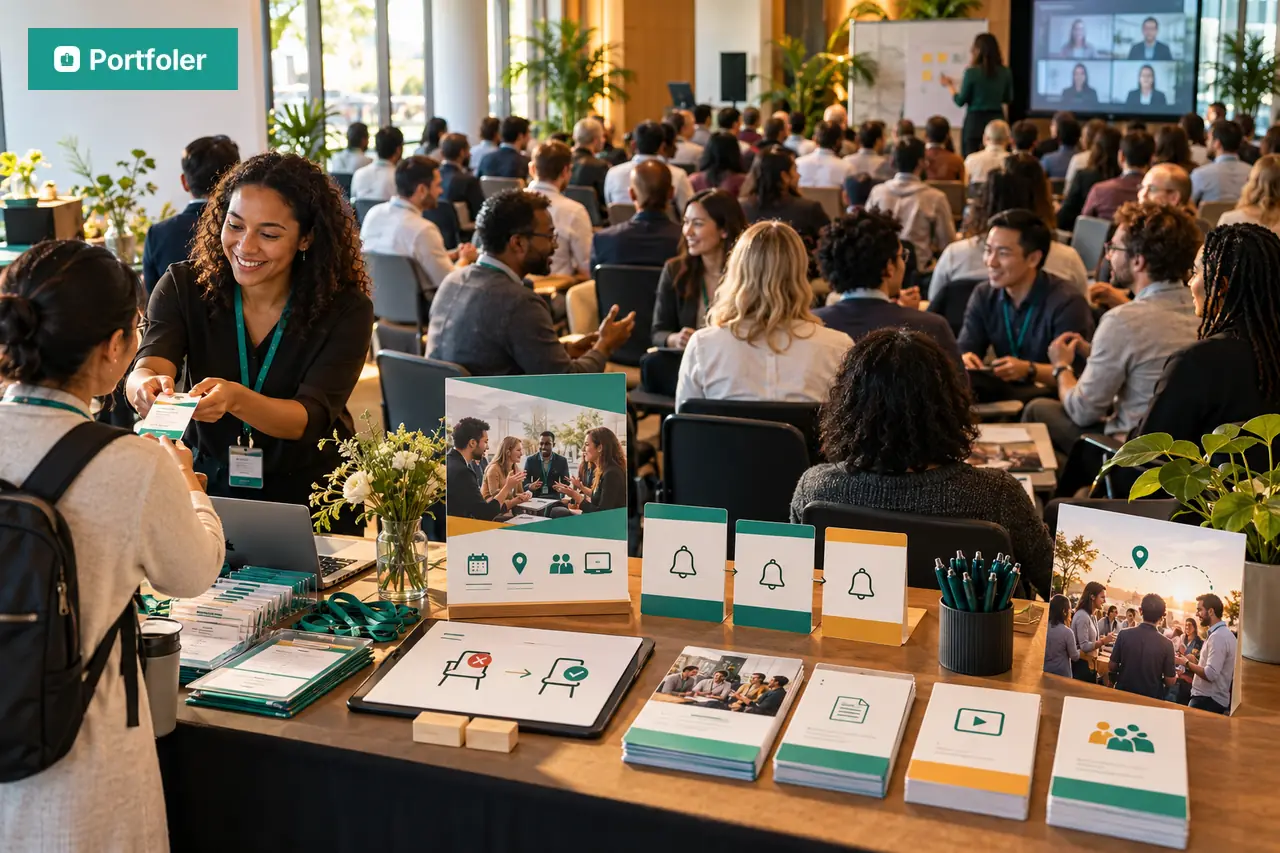
Running a professional event is a moment of truth: unlike a post, you cannot tell yourself stories about it. Either people show up, or the room is empty. And the gap is brutal — eighty registered, thirty in the seats. It is almost never a content problem. It is a problem of announcement, format and follow-up. Here is how to handle all three.
Say what attendees get, not what you plan to present
Most announcements describe a programme. The reader is after one piece of information: what do I get out of this, and is it worth my afternoon?
- A title that promises a concrete benefit, not a vague theme ("Hiring without an agency" rather than "HR round table").
- Say who it is for, explicitly: someone unsure they belong in the room does not come.
- State the level and the format: a lecture and a hands-on workshop are not the same commitment.
An event for everyone interests no one. Name your audience and accept that you are excluding the rest.
Treat date, venue and format as decision criteria
These look like logistics. They are in fact the first reasons people say no, and you can anticipate every one of them.
- The date: avoid Fridays, the eve of holidays, and slots that force people to book half a day off.
- The venue: exact address, access, parking. A vague location is a location nobody travels to.
- The format: in person to build relationships, online to widen the audience, hybrid to do both — knowing that badly run hybrid always sacrifices the remote attendees.
- The duration: announce a finish time, and stick to it. That is what unlocks tight calendars.
Follow up — this is where attendance is won
Registering three weeks ahead is not a commitment, it is an intention. Without a reminder, a third of registrations simply forget to turn up. Following up is not pestering: it is a service.
- One reminder a week ahead, with the programme and a calendar invite.
- One reminder the day before, short, with the address and the time.
- On the day for online events: the link, one line, nothing else.
- Make cancelling easy: someone who drops out frees a seat, a no-show wastes it.
Don't let the connection die at the exit
The real return on an event is not a full room: it is the relationships that outlive the day. And almost everyone stops right at the point where it gets interesting.
- Send the slides, the resources and anything you promised within 48 hours.
- Give people a way to reconnect: speaker profiles, a group, the next date.
- Collect brief feedback while the memory is still fresh.
- Announce what comes next: a one-off event is a hit, a series is an audience.
In short
Filling a room comes down to four things: promise a clear benefit to a named audience, remove the date and venue objections, follow up right until the last day, then keep the connection alive afterwards. Create, publish and manage registrations for your professional events on Portfoler.com.