The interview went well. You answered the questions, shared a smile, shook hands — and then, nothing. The days go by, your inbox stays quiet, and a small voice creeps in: "Should I follow up? What if I come across as pushy? Could I ruin everything?"
That silence after an interview is one of the most uncomfortable moments of a job search. You are caught between wanting to show your motivation and fearing you might bother an already-overloaded recruiter. Good news: a well-crafted follow-up message does not bother anyone — it sets you apart. Here is how to follow up with the right tone, at the right time, using the right words.
Why following up truly changes things
A recruiter receives dozens of applications and meets several candidates for the same role. When skills are equal, the details often make the difference. A thoughtful follow-up message sends three strong signals:
- Motivation: you confirm that you are genuinely interested in this role, beyond the interview.
- Professionalism: knowing how to follow up tactfully is a valued skill in almost every field.
- Recall: you stay top of mind for the recruiter at the very moment they compare candidates.
Following up is not begging. It is continuing a professional conversation you started together. Done well, it places you back among the finalists.
The thank-you email within 24 hours
The first follow-up is not really a follow-up: it is a thank-you email, sent within 24 hours of the interview. It is the highest-return gesture in the entire process, and yet many candidates forget it.
This message should be short, sincere and personalized. Thank them for their time, recall a specific point from the conversation that stayed with you, and restate your interest.
Short template example:
> Hello [First name], > Thank you for our conversation today. I especially enjoyed our discussion about [specific topic covered], which confirmed my enthusiasm for the [job title] position. I remain available for any further information and would be delighted to join your team. > Kind regards, [Your name]
This immediate gesture shows your attentiveness and good manners — two qualities no line on a résumé can replace.
When and how to follow up if you get no reply
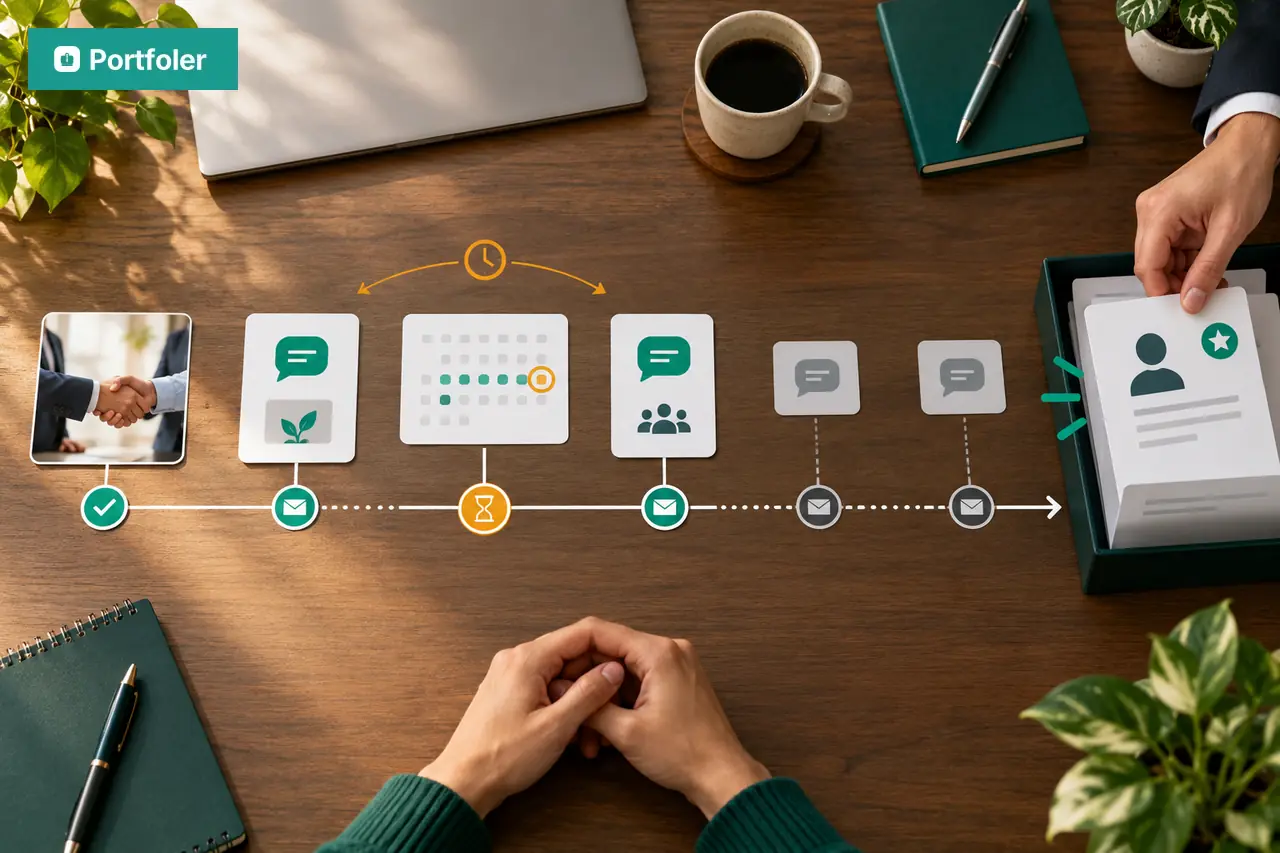
Once the thank-you email is sent, patience takes over. But patience does not mean endless silence. The simple rule: respect the announced timeline, then add a margin.
- If the recruiter gave a date ("we will get back to you by the end of the week"), wait for that deadline to pass, then follow up a day or two later.
- If no timeline was communicated, wait 5 to 7 business days before your first follow-up.
- Space out later follow-ups by at least a week, and do not exceed two or three messages in total.
Keep the tone positive and light. You are not demanding an answer: you are expressing interest and offering your help. A good follow-up message reminds them who you are, restates your motivation, and leaves the door open, without ever putting the recruiter under pressure.
What to write: short templates ready to adapt
The best follow-up message is brief, polite and easy for the recruiter to process. Here are two templates to personalize.
Follow-up after the announced deadline:
> Hello [First name], > I hope you are well. I am reaching out regarding the [job title] position, which we discussed on [date]. I remain very motivated to join your team and would be happy to provide any information that could help your decision. > Thank you in advance, and I wish you a great day. > [Your name]
Courtesy follow-up, after a long silence:
> Hello [First name], > Having not heard back, I simply wanted to confirm my interest in the [job title] position. If the process is still ongoing or a decision has been made, I would be grateful to be informed. > Thank you for your time, and I look forward to connecting again. > [Your name]
Always adapt the first name, the exact job title, and one concrete detail. A generic message is spotted immediately; a personalized one stands out.
Mistakes to avoid at all costs
A few missteps are enough to turn a follow-up into a bad memory. Keep these points in mind:
- Following up too soon: sending a message the day after an interview to ask for the decision reveals impatience.
- Following up too often: more than three messages, or follow-ups every couple of days, become counterproductive pressure.
- Using a passive-aggressive tone: "I still have not heard back…" closes doors. Stay courteous in all circumstances.
- Sending a generic message: without personalization, your follow-up looks like a copy-paste.
- Spreading across channels: bombarding email, phone and messages at once feels intrusive. Choose one main channel and stick to it.
The common thread: stay professional, respectful and positive, even in the face of silence. A candidate who handles the wait well leaves an excellent impression, even without landing that particular job.
In summary
Following up after an interview is not a gamble: it is proof of professionalism. Thank them within 24 hours, respect the announced timelines, personalize every message, and always keep a positive tone. Two or three well-managed follow-ups are worth more than anxious silence — or clumsy harassment.
And so the recruiter can easily find all your information when they think of you, keep a professional profile that is always up to date. On Portfoler.com, build your profile, résumé and portfolio in minutes, then connect directly with recruiters through the built-in messaging. Your next opportunity starts with a profile that showcases you — and with a follow-up message that makes the difference.