Teachers pass on knowledge, but the job does not stop at the lesson. They build a progression across a whole year, adapt a single course to thirty different pupils, assess, remediate, guide and talk with families. A public service profession in the fullest sense — demanding, and foundational for society.
Role description
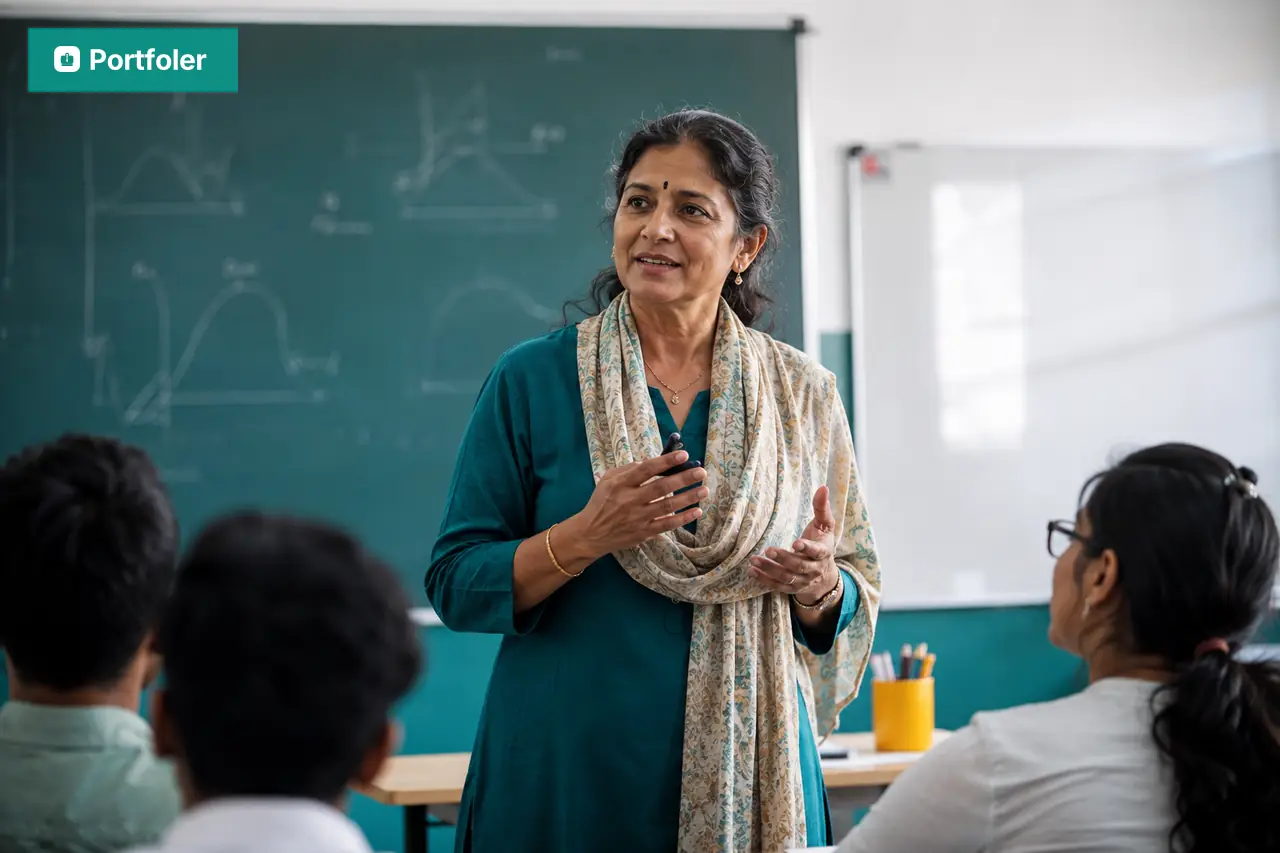
A teacher designs and delivers lessons to pupils or students within official curricula, from primary school to higher education. They set out a yearly progression, prepare each unit, lead the classroom, assess learning outcomes and support every pupil through difficulties as well as successes.
The role differs clearly from that of a corporate trainer, who works with adults in companies over short sessions and without a national curriculum, and from that of a learning designer, who builds training programmes without necessarily delivering them. Teachers work in the long run: they follow one group through a full school year, with accountability for certified learning outcomes, a strict regulatory framework and an educational responsibility that reaches well beyond the subject taught.
Key responsibilities
- Build a yearly progression aligned with official curricula and prepare each teaching unit.
- Lead the classroom: explain, demonstrate, question, and maintain conditions that support learning.
- Differentiate teaching to account for varying paces, levels and special educational needs.
- Design and mark assessments, analyse results and put remediation in place.
- Handle individual follow-up: reports, progress meetings, guidance, dialogue with families.
- Contribute to school life: educational projects, trips, staff meetings, examinations.
- Keep learning continuously about the subject, teaching methods and educational technology.
Required skills
Hard skills: expert command of the subject, didactics and unit design, knowledge of curricula and competency frameworks, assessment design and calibration, differentiated instruction, classroom management, educational technology, and knowledge of the school regulatory framework.
Soft skills: benevolent authority, clarity of expression, patience, real-time adaptability, fairness, resilience under emotional load, and the ability to work in a teaching team and engage with parents.
Salaries worldwide
Teacher pay depends above all on the country, the employment status (civil servant, contract staff, private sector) and the level taught. The salary table by country below gives indicative gross annual ranges in local currency. The gaps are considerable: teaching is well paid in Germany, Canada, Australia and the international schools of the Gulf, and markedly less so in several European countries. International private schools often pay above the local public scale, with housing and transport included in some countries.
Career path
The profession opens several trajectories in every country:
- Entry level (0 – 3 years): taking on classes, mentoring by a tutor, consolidating classroom management.
- Established (3 – 10 years): pedagogical mastery, cross-cutting responsibilities (form tutor, year coordination), first specialisations.
- Experienced (10 – 20 years): subject coordination, peer training, mentoring newcomers, sitting on examination boards.
- Expert (20+ years): school leadership, inspection, curriculum design, higher education, or a move into learning design and adult training.
Moving abroad into international school networks is a common trajectory, and often a considerably better paid one.
Education & training
Entry is regulated everywhere, though the route varies by country:
- Competitive public service examinations after a master's degree, in France and several European countries.
- Bachelor's or master's degree in education, completed by a teaching qualification and supervised placement (PGCE in the UK, state certification in Canada and the United States).
- Teacher training colleges in Morocco and many other countries.
- The private and international sector recruits more flexibly, usually on a subject degree plus a recognised teaching certification.
Industries & opportunities
Teachers work in primary schools, secondary schools, higher education, private institutions, international schools, special education and language centres. Many also extend their activity into tutoring, private lessons, educational resource production, school publishing or online teaching. Shortages across many subjects — mathematics, sciences, languages — keep hiring demand durably high.
In summary
An essential, stable and meaningful profession, with openings worldwide and genuine international mobility. If you teach, guide and help others progress, create your profile on Portfoler.com, highlight your subjects and certifications, and attract the schools that fit you.
 United States
 United Kingdom
 Germany
 France
 Canada
 United Arab Emirates
 Morocco
 India
 Spain
 Australia
 Netherlands
 Brazil