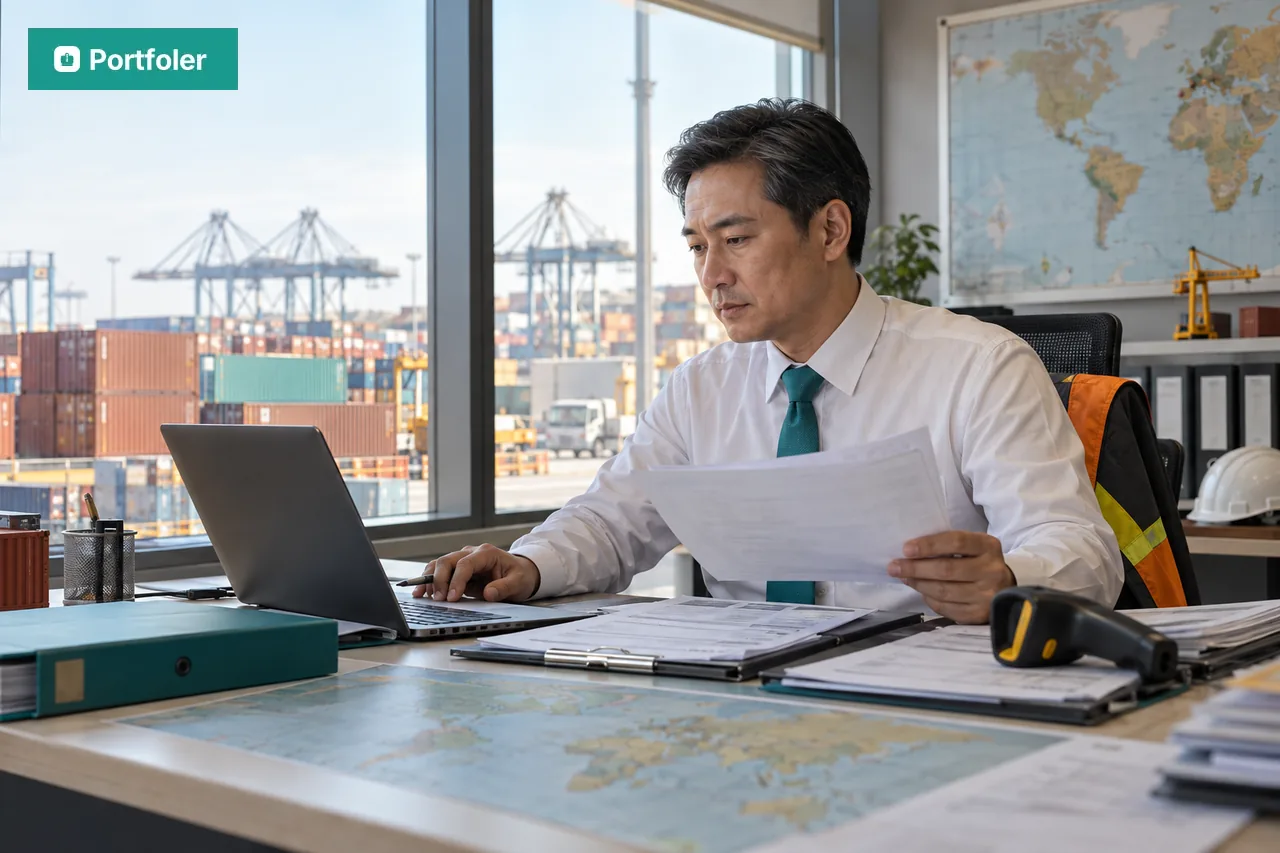
The Customs Broker handles the formalities that allow goods to enter or leave a territory legally. Working for a freight forwarder, a licensed brokerage firm or directly for an importer/exporter, they classify products, calculate duties and taxes, and file declarations with the customs authorities.
Role overview
A key link in international trade, the Customs Broker turns commercial documents (invoices, packing lists, certificates of origin) into compliant declarations. They determine each item's tariff classification, customs value and origin, then select the most suitable customs procedure: release for free circulation, bonded warehouse, inward processing, transit and more.
They work on customs IT systems (ACE in the United States, ATLAS in Germany, Delta G in France, BADR in Morocco) and often under tight deadlines, since every hour a container is held up has a cost. They are also the point of contact for customs officers during documentary or physical inspections.
Key responsibilities
- Check and complete commercial and transport documents.
- Classify goods in the tariff nomenclature (Harmonized System, TARIC).
- Determine the customs value and origin of goods.
- Calculate customs duties, VAT and applicable taxes.
- Prepare and file import, export and transit declarations.
- Select and optimize customs procedures (bonded warehouse, temporary admission, inward processing).
- Follow up on inspections and liaise with the customs administration.
- Advise clients on regulations (Incoterms, licenses, export controls).
Required skills
Hard skills: national and international customs regulations, tariff nomenclature (HS, TARIC), rules of origin and free-trade agreements, customs valuation, Incoterms, special customs procedures, export controls and dual-use goods, customs clearance software, business English.
Soft skills: rigor, precision, responsiveness, ability to handle deadline pressure, customer service mindset, organizational skills, discretion.
Salaries around the world
Customs Broker pay varies by country, the volume of port or airport activity and the type of employer (freight forwarder, brokerage firm, manufacturer). Profiles who master complex procedures and rules of origin are the most valued. The salary-by-country table below gives indicative gross annual ranges, in local currency, for an experienced profile.
Career path
- Junior (0 – 2 years): customs clerk or forwarding agent, preparing files.
- Mid (2 – 5 years): Customs Broker, independently managing a client portfolio.
- Senior (5 – 8 years): senior broker or customs clearance team lead, complex files and special procedures.
- Expert / Lead (8+ years): customs manager, customs consultant or Trade Compliance Manager.
Education & training
- Associate's or Bachelor's degree in international trade, transport and logistics or import-export operations.
- Specialized customs programs and professional certificates.
- Master's degrees in customs law or international trade for management positions.
- Depending on the country, a customs broker license or accreditation (e.g. the U.S. Customs Broker License exam).
Industries & opportunities
Customs Brokers work for freight forwarders and licensed brokerage firms, at ports, airports and logistics hubs, for express integrators and within the import-export departments of manufacturers and retailers. Increasingly complex trade rules and the growth of cross-border e-commerce keep demand steady.
In short
A technical, regulation-driven role that is essential to smooth international trade. If you are meticulous and drawn to global commerce, create your profile on Portfoler.com and connect with companies hiring Customs Brokers.
 United States
 United Kingdom
 Germany
 France
 Belgium
 Netherlands
 Canada
 United Arab Emirates
 Morocco
 India
 Spain